Hairspray at the Umbrella Arts Center · The First Texture Ready™ Case Study · Art & Soul Consulting
The First Texture Ready Case Study

A show with the word hair in the title. Planned for, from the start.

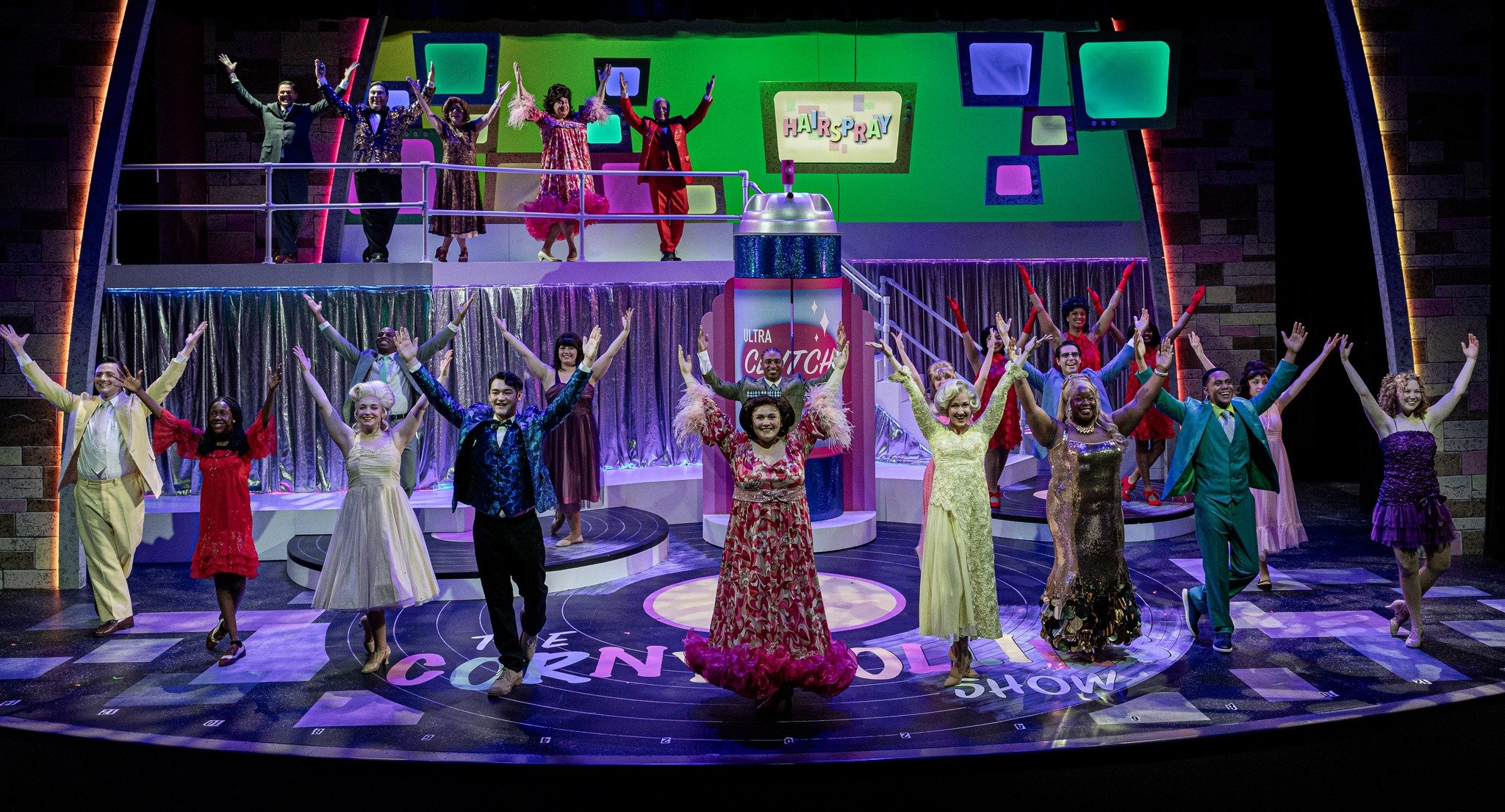
Hairspray at the Umbrella Arts Center became the best-selling production in the theater's history. It ran cleanly from first preview to closing, with no major hair or wig disruptions. The infrastructure that kept hair from ever becoming one was the point.

Hairspray · Umbrella Arts Center · 2026 · Photo by Jim Sabitus
The Result
Best-selling production in the theater's history to date.

Opened on schedule. Ran cleanly from first preview to closing. No major hair or wig incidents reported across the run.

ProductionHairspray
TheaterUmbrella Arts Center, Concord, Massachusetts
Producing Artistic DirectorBrian Boruta
Director & ChoreographerNajee A. Brown
Cast size25 performers
Hair scopeAll hair types and textures, including protective styles, custom wigs, and a documented no-touch boundary
Hair LeadArt & Soul Consulting (Texture Ready)
Licensed SpecialistNadja Vanterpool
EngagementMarch to May 2026, pre-production through close
Run datesApril 26 to May 17, 2026

The undefined "qualified" gap.

The gap in one line

Licensed is not the same as qualified. A production can hire a licensed stylist, act in complete good faith, and still seat a Black performer in front of someone never trained on their hair.

Both major performer unions now address hair. SAG-AFTRA's film and television contract gives principal performers a consultation about their hair and makeup, and requires productions to provide qualified personnel or reimburse the performer for outside services when they cannot. Actors' Equity has added hair-styling protections to its resident-theater agreement as part of its equity standards. The word that does the work in these contracts is qualified. What none of them define is what qualified actually means.

Licensing does not fill the gap. In most states, a cosmetologist can earn and keep a license without ever being trained or tested on textured hair, and only a small number of states test it on the licensing exam at all. The gap is not a question of intent. It is a question of standard.

Art & Soul has spent years documenting where that gap lands. The most consistent issue Black performers raise is not preference, but hair as a recurring site of harm, double standards, and avoidable stress under production pressure. Institutions name equity as a value and still treat textured hair as an exception, a last-minute scramble, or something a performer is left to manage alone. That is exactly when risk spikes.

The Texture Ready Hair Lead Competency Standard exists to close that gap. It defines what qualified means at the production level, across six domains: Literacy, Fluency, Architecture, Consent, Care, and Escalation. This case study is the first documented application of that standard on a live production.

The production that said yes. Brian Boruta, Producing Artistic Director at the Umbrella, and Najee A. Brown, who directed and choreographed, chose to engage Art & Soul as Hair Lead rather than absorb hair into costume or hand it to the performers. The choice grew out of a long partnership. Boruta attended Art & Soul's 2023 "Black Hair is Hair" workshop himself, choosing to learn in an area new to him as an artistic leader. Hairspray was Najee Brown's fourth production with the team. The word hair is in the title. Set in 1962 Baltimore, the show stages the politics of Black hair directly. This was the right place to prove that textured hair belongs in the production plan, not in the margins.

"I had locs, and I cut them off because I was told it was not professional. It is one of my biggest regrets. That hair was how it grew out of my head. It was a symbol of freedom."
Najee A. Brown · Director & Choreographer

Not abstract. The areas that decide whether hair support actually holds.

The six domains name what is structurally necessary to produce equitable, effective hair support in real production environments. Texture Ready puts them to work in two parts that move together.

Train your team
Six domains, six hours.
Equip your production
A custom toolkit.
Domain One

Literacy

Hair knowledge joined to cultural and historical knowledge.

The Domain

Literacy is knowledge of all hair types, their biology, their range, their breakage risk and care needs, joined to the cultural and historical knowledge of what that hair has meant and cost. You cannot lead hair you do not understand, and you cannot understand Black hair without understanding its history. The bar is the one every other department already meets. A lighting designer commands the full scope of light without personally touching every instrument. The Hair Lead holds that same mastery across every texture.

What this production needed

A show set in 1962 Baltimore, built around hair as story, with a cast spanning every hair type, from straight to coily, along with protective styles. Performers arriving with real histories: hair overprocessed in past productions, length cut without consent, looks chosen by people who did not know the hair they were touching.

What was deployed

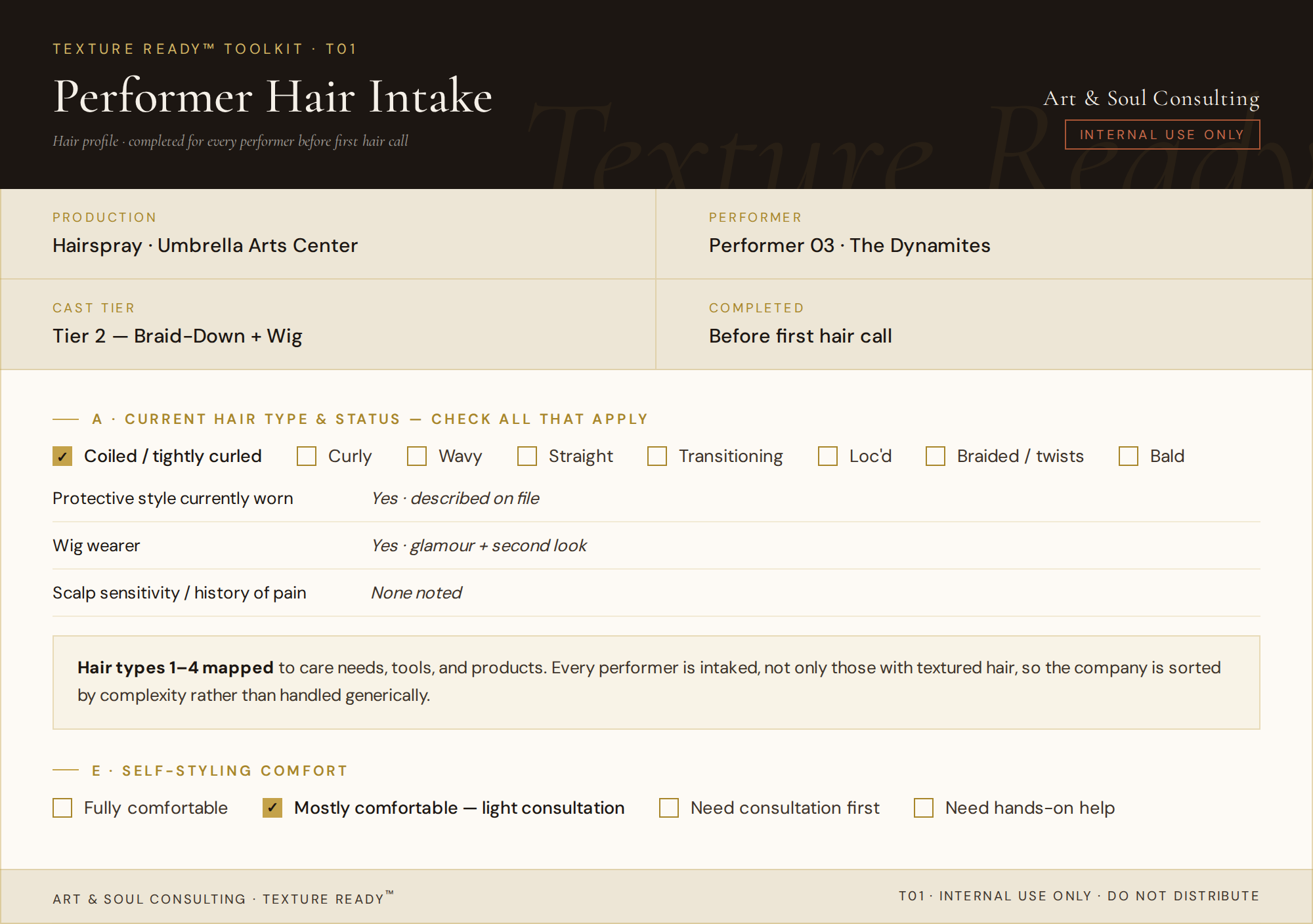
An intake adapted to capture current hair status and type for every performer, not only those with textured hair. Hair types one through four mapped to actual care needs, tools, and products. A four-tier cast classification that sorted the company by complexity, so nothing was handled generically.

What changed

Hair conditions, types, and histories were known and planned for, rather than discovered at first dress. Performers met a team that could speak their hair fluently.

"When you sent the hair form, my heart. I was so excited to have representation for my hair, and for me as a Black woman who is natural. That was so meaningful, and something I had never experienced before."
Simone AlyseEnsemble (the Dynamites)
An anonymized Texture Ready hair intake form: a performer's hair type and status, with hair types one through four mapped to care needs
The intake that opens every engagement (anonymized). Hair type and status captured for the whole company. The Literacy instrument.
Domain Two

Fluency

Styles, install times, maintenance, costs, feasibility.

The Domain

Fluency is the working command of styling itself: which looks are achievable on which hair, how long an install takes, what maintenance a style needs across a full run, what it costs, and what is feasible inside a tech timeline. Literacy knows the hair. Fluency is the masterful understanding of textured hair, protective styles, and their coordinating specifics.

What this production needed

Three performers needing braid-downs under glamour wigs. Protective styles that had to survive a full run and let performers live their lives outside the theater. A principal whose wig had to be built to work with her own hair, on her terms. Period looks across a large ensemble.

What was deployed

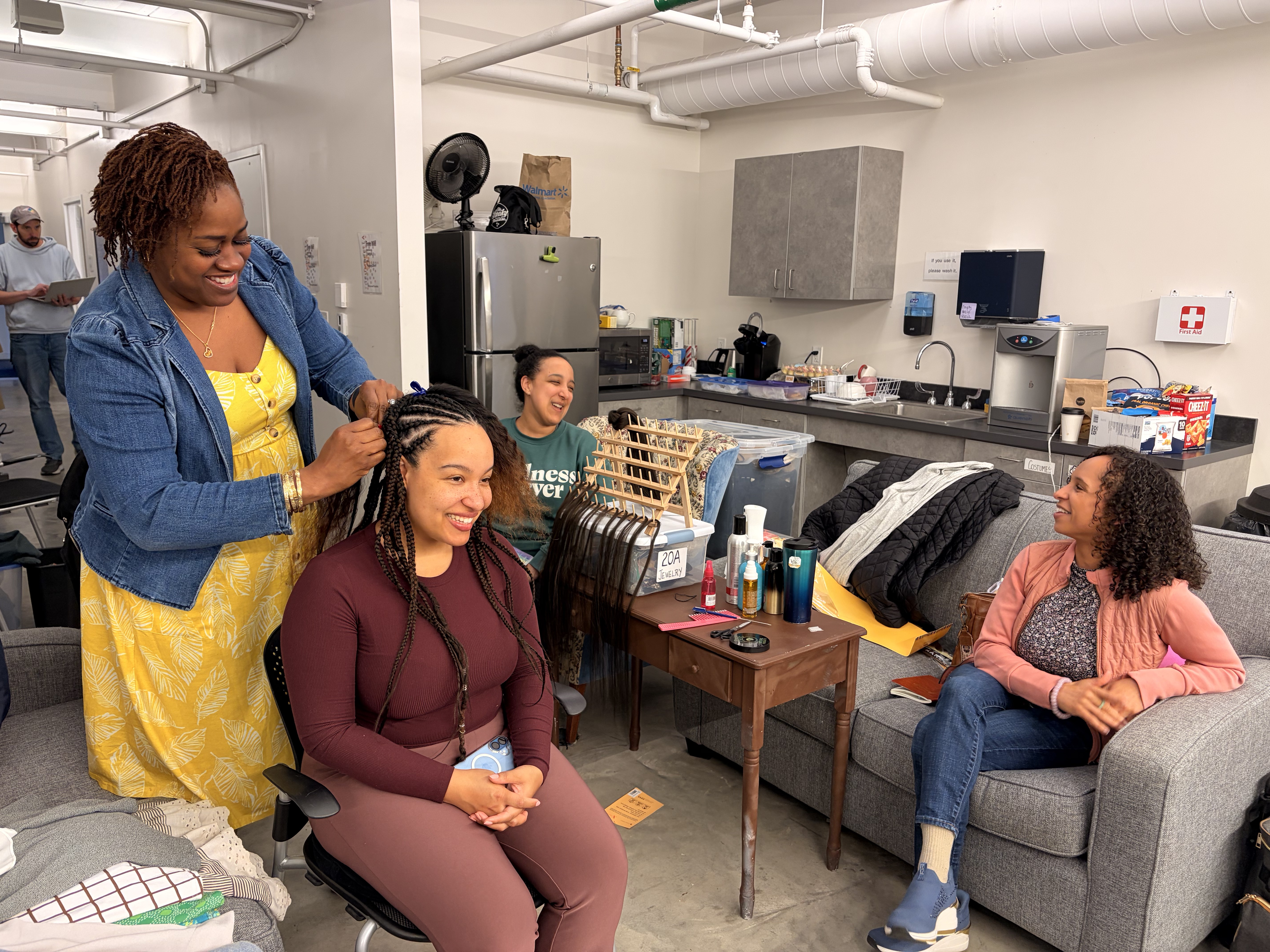
Texture Ready Salon Day: a single dedicated day with a licensed braider on site, materials sourced that morning, every textured-hair prep handled in one place, on the performers' paid time. The braider had consulted in advance on each look, so the day was execution, not guesswork. All three braid-downs were completed in one day. Those braids doubled as how each performer wore her hair through the run, not just what sat under a wig.

What changed

Textured-hair prep was done right, on schedule, by a qualified specialist, in the building. When an early wig reference proved unworkable on a performer's own hair, a modified design was developed in collaboration, and it worked the first time. A wig is not finished when it is built. It is finished when it works on the hair that has to wear it, performance after performance.

"I have never had a Salon Day in a theater production before. That alone was incredible. As a natural girl, how people handle my hair really matters to me, and it was good to be in a space with Black women."

Simone AlyseEnsemble (the Dynamites)
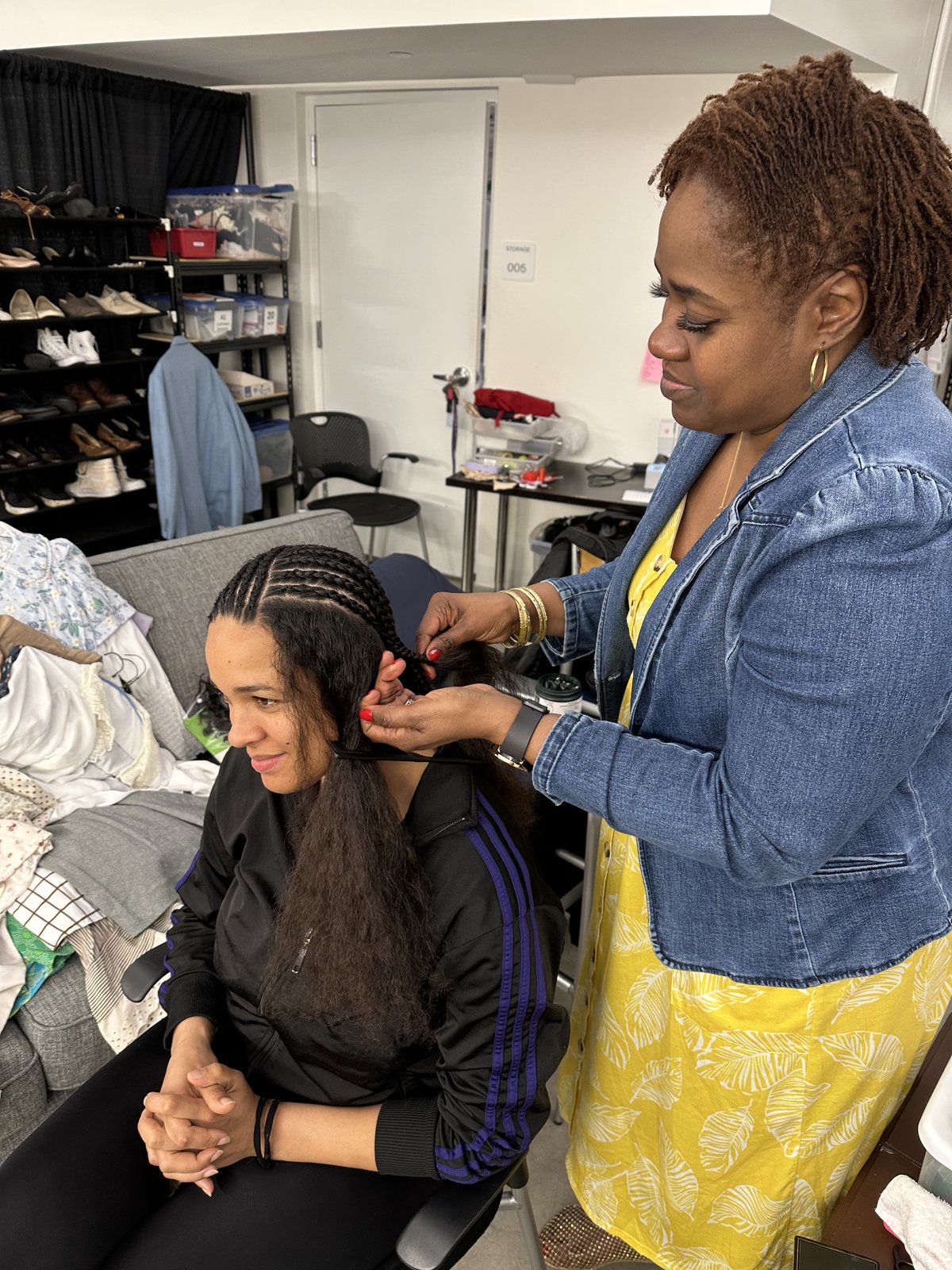
Texture Ready Salon Day in a green room at the Umbrella Arts Center: a braider installs a protective style on a seated performer while castmates talk nearby
Texture Ready™ Salon Day, in the building: every textured-hair prep handled in one room, on the performers' paid time.Pictured: Nadja Vanterpool, Simone Alyse, Ari Welch, Kira Troilo
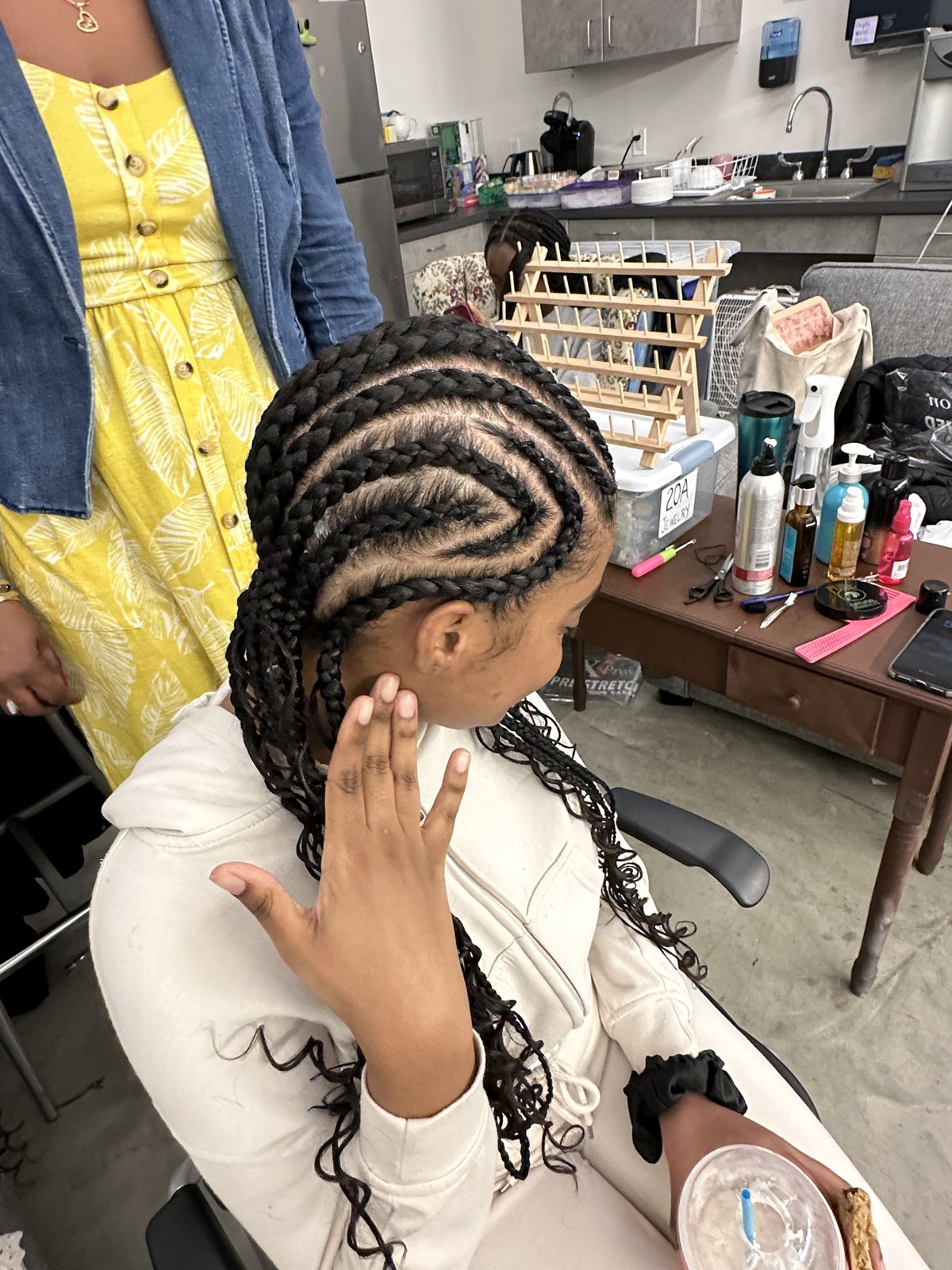
A performer's freshly installed feed-in braids on Texture Ready Salon Day, styling station behind her
Texture Ready™ Salon Day: a completed braid-down, built to live under a wig and out in the world.Pictured: Nikita DaRosa
A licensed braider installing a protective style on a seated performer during Salon Day
The install in progress: production-side textured-hair labor, named and scheduled.Pictured: Pearl Scott, Nadja Vanterpool
Domain Three

Architecture

Production planning, budget authority, infrastructure.

The Domain

Architecture is hair built into the production itself: planning, budget authority, and infrastructure. It is the difference between hair as a department with a named owner, a line in the budget, and a place on the call sheet, and hair as something that falls to costume, to wardrobe, or to the performer at seven o'clock. When hair is everyone's job, it becomes no one's job. A department needs an owner.

What this production needed

Leadership for a twenty-five-person cast, five hair approaches, and nineteen wigs, with no standing hair crew. A budget that accounted for textured-hair labor and protective styling before casting was even locked. Hair on the daily call sheet like any other production element.

What was deployed

Art & Soul engaged as Hair Lead at the leadership level, in production meetings alongside the director and producer. A pre-determined hair budget, built so the producer knew the cost of the hair plan in advance. The four-tier cast plan. A nineteen-wig design specification. A hair-plan one-pager for every performer. Hair scheduled onto the daily call by the stage manager. The director himself carried Texture Ready competency, equipped to read the hair plan and make faster, better-informed calls.

What changed

Hair became a planned function with an owner, a budget, and documentation, rather than an afterthought split between departments and the performers themselves. The role does not require a permanent new hire or a big budget. On most productions it can be carried by an existing team member, a costumer, a stage manager, an assistant director, equipped to the six competencies.

"We have costume designers. We have sound and lighting. Hair should be a design too."

Pearl ScottEnsemble (the Dynamites), Dance Captain
From the Hair Lead
With twenty-five people, having it written down meant you could say, this person asked for this specifically, and this person asked for this. It let the actors raise questions later, because the door had been opened from the start.
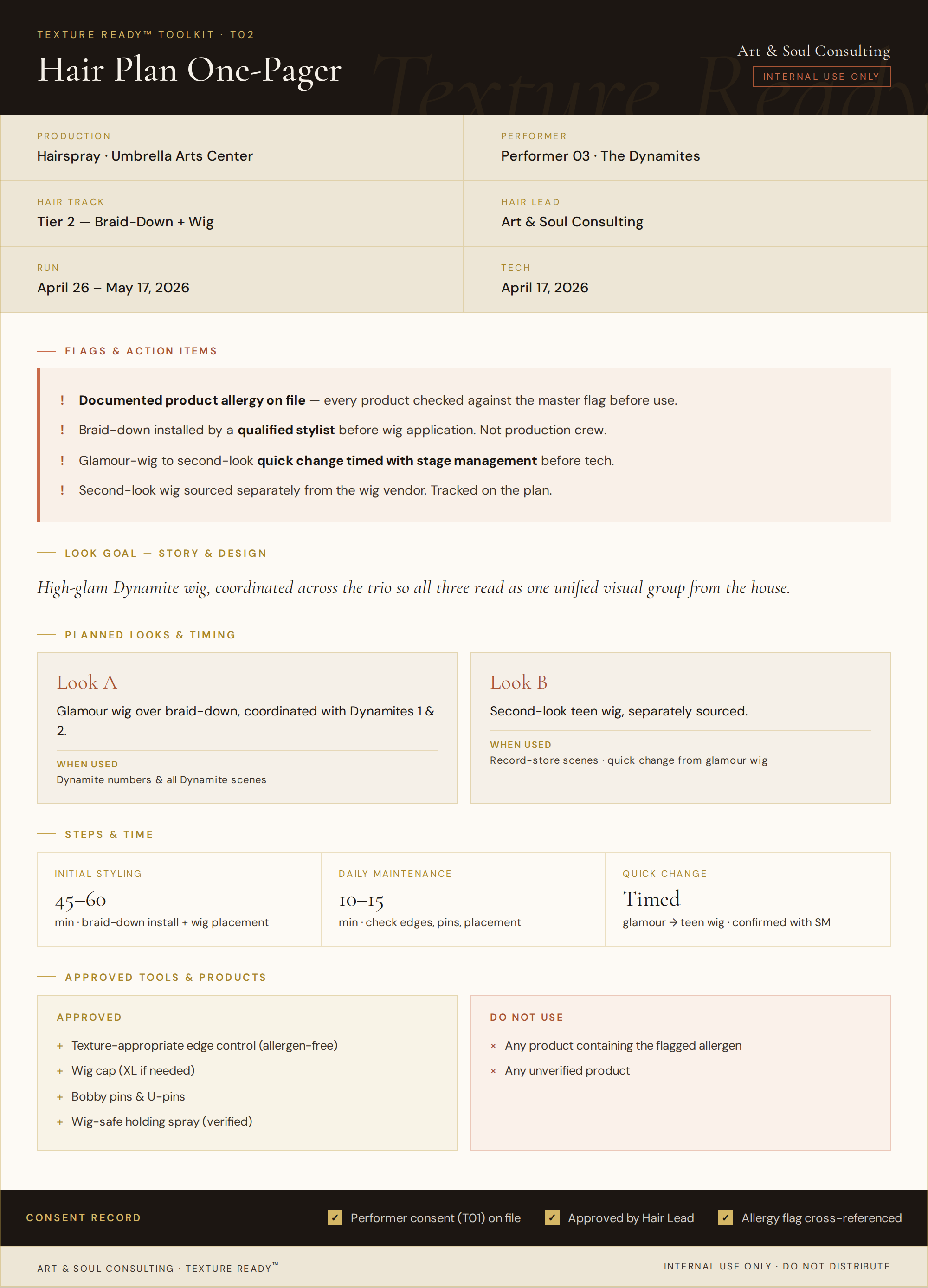
An anonymized Texture Ready hair-plan one-pager: production, role, hair track, flagged action items, planned looks with timing, approved and prohibited products, and a consent record
A per-performer hair-plan one-pager (anonymized). The Architecture instrument from the Texture Ready™ toolkit, deployed inside the engagement.
Domain Five

Care

Relational competency, communication, performer collaboration. The persuasive anchor of this work.

The Domain

Care is the relational competency: communication, collaboration, and the work of making a performer feel seen rather than processed. It is the domain that decides whether a performer trusts the room. On a show that has Black hair boldly on display, it is not the soft part. It is the work. The aim is not cultural competence, a box checked. It is cultural confidence: the ability to talk about loaded things with humility while still feeling equipped, knowledgeable, and empowered to lead.

What this production needed

A cast carrying the weight of past harm and the low-grade vigilance that comes from never being sure the room will get it right. Performers who, in their own words, had learned to do their own hair, come in early, pay out of pocket, and not ask for too much.

What was deployed

Individual consultations with nearly every performer in the cast. A Hair Lead positioned as the buffer, so performers did not have to advocate, over-explain, or carry the labor of being the only one in the room who understood their hair. When a performer needed more support than the original plan assumed, the team caught it early and adjusted.

What changed

Performers reported feeling seen, safe, and freed of a burden they had carried so long they had stopped naming it.

"Every time, I know things are going to be handled with love, care, and honor. They make sure every person feels seen and not just styled. It is identity work. If you are Black, you know your hair is part of your identity. It is a soul thing."

Najee A. BrownDirector & Choreographer

"It is transformative to come into the space and not be scared. Not to get twelve inches cut off."

Pearl ScottEnsemble (the Dynamites), Dance Captain
A performer at ease during an individual hair consultation on Salon Day
An individual consultation: the work of being seen, not just styled.Pictured: Pearl Scott, Nadja Vanterpool
The hair team and company members together on Salon Day
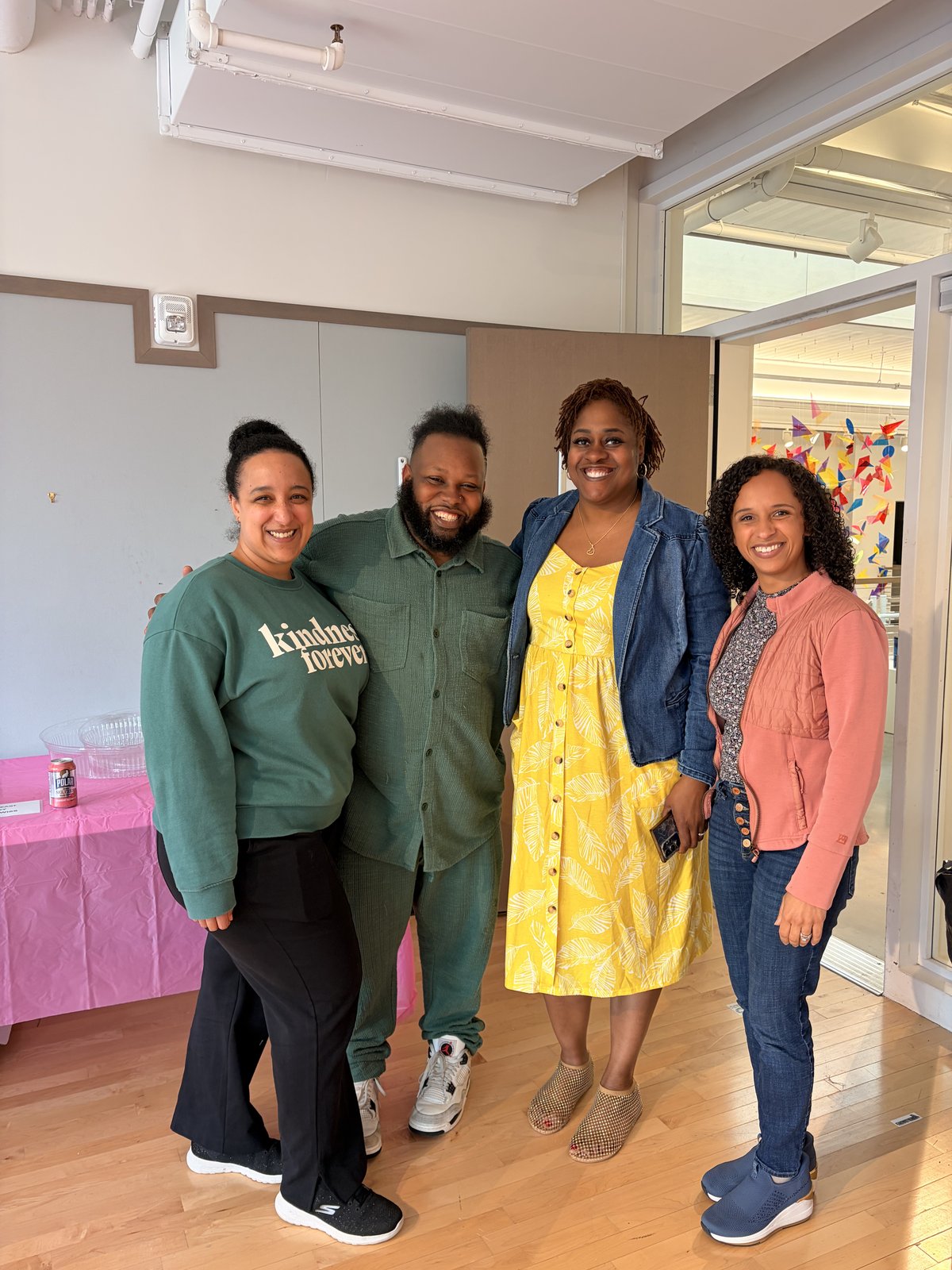
One room, one team, on the performers' paid time.Pictured: Ari Welch, Najee Brown, Nadja Vanterpool, Kira Troilo
Domain Six

Escalation

Crisis management, the authority to call a hold, a documented pathway.

The Domain

Escalation is the defined pathway for when something goes wrong: the authority to call "hold," a documented route for raising a problem, and the discipline to absorb a situation without dropping the show. The aim is to build pathways that keep most problems from ever becoming crises, and to have a plan for the ones that do.

What this production needed

Live theater runs on moving parts, and close to tech a miscommunication arose about the wigs. The specifics matter less than the shape of it: a gap surfaced late, the opening date was fixed, and the production needed a way through that did not end in a missed performance. What a standard answers is whether someone is positioned to absorb it.

What was deployed

Because hair had an owner and a documented escalation pathway, the response was calm and fast. Art & Soul coordinated the wig solution across the resources available, kept the team informed, and made the calls that protected the opening. The same discipline had already handled an earlier moment in the cast quietly, before it could become anything larger.

What changed

The show opened on time and ran cleanly from first preview to closing. The wig miscommunication never reached the audience, never delayed a performance, and never became a story the production had to manage. That is what escalation infrastructure buys: not the absence of problems, but the capacity to absorb them before they reach the stage.

"I have been part of productions that did not take these steps, and the aftermath of recovering from the damage takes far more time. I love that they put the steps in first. At moments of tension, they still find ways to lead with grace."

Najee A. BrownDirector & Choreographer
They make sure every person feels seen and not just styled. It is a soul thing.
Najee A. Brown Director & Choreographer, Hairspray

What changed, in numbers and in their words.

For the performers
In numbers
  • Every performer in a 25-person cast had a documented hair plan before first dress rehearsal.
  • Five distinct hair-management approaches coordinated under one Hair Lead, from braid-downs and custom wigs to natural-hair grooming, guided self-styling, and period hat looks.
  • Boundaries and allergies documented and honored for the full company, including an absolute no-touch boundary.
  • Two performers moved to fuller hair support early, before a small gap could grow into a tech-week scramble.
  • A stage manager who knew she had a Hair Lead to rely on, and could flag concerns in real time.

"Being asked how I felt about things was wonderful. The respect I got for my concerns was wonderful."

Meryl Galaid · Ensemble (Prudy)

"I don't have to feel like I have to have a big voice to be taken care of."

Pearl Scott · Ensemble (the Dynamites), Dance Captain

For the production
In numbers
  • Hairspray became the best-selling production in the Umbrella's history.
  • Opened on schedule and ran cleanly, with a late wig miscommunication resolved before opening and no impact on the run.
  • Risk removed and time protected: no tech-week scramble, minimal emergency spend, no performer left to solve hair alone.
  • Hair on the daily call sheet as a scheduled production element, not an off-book errand.
  • A documented, per-performer hair record for a cast of twenty-five.

"Texture Ready gave us the information, the resources, and the tools we needed to make a roadmap and individual plans for each actor that met the needs of the production, respected the budget, and cared for the actor both on stage and in their daily lives away from the show."

Brian Boruta · Producing Artistic Director, Umbrella Arts Center

Five things this production settles.

1
The standard is operational, not theoretical.Texture Ready was applied, in full, on a live production, and it held under real conditions.
2
The Hair Lead role is real, replicable, and budgetable.It can be planned, priced, scheduled, and owned like any other department, held well by a qualified practitioner of any race, and on most productions carried by an existing team member trained to the standard rather than a new hire.
3
Qualified has a definition.It is the six domains, demonstrated here, where contract language has so far left the word undefined. Qualified is not a person. It is a production. A qualified Hair Lead is the one equipped to determine what qualified means in the room, and to build trusted relationships with the stylists who do the hands-on work.
4
Production-side labor for textured hair is no longer invisible.It can be named, documented, and budgeted for, which means it can finally be resourced.
5
The standard protects every performer, not only Black performers.It is built for the most exposed, and that rigor raises the floor for the entire cast, including a performer with no textured-hair considerations who needed support and got it.

The same gap exists on set. The stakes are higher.

SAG-AFTRA requires productions to provide qualified hair-and-makeup personnel, or reimburse the performer when they cannot. The word does the same work on a film set that it does in a theater contract, and it is left just as undefined. The Texture Ready standard answers it the same way: six domains, an owner, a documented plan.

The infrastructure proven on Hairspray translates directly to the pace and scale of film, television, and commercial work, where a single unplanned hair day costs far more than a theater's entire hair budget.

On the horizon

A dedicated film and television case study is in development, built around the specifics of the on-set process. To talk about your set, season, or shoot:

Start a film/TV conversation

This production was not unusual in its challenges. It was unusual in being planned for.

The same standard applies to your season, your show, your set. Texture Ready works in two parts that move together. The training builds the person. The toolkit standardizes the production.

Part One

Train your people.

The six domains in six hours, the training that equips a qualified Hair Lead. Cohort 2 begins June 24, 2026, across three live virtual sessions.

Join Cohort 2
Part Two

Equip your production.

A Readiness Engagement brings the standard and a custom toolkit into your specific show, tailored to its realities and deployed inside the work.

Start a Readiness Engagement

"This is not just a tool for your hair lead, or your costume designer, or your production manager. It is a tool for you, if you want to center company care, make good decisions on budget and artistic vision, and provide support all the way through closing."

Brian Boruta · Producing Artistic Director, Umbrella Arts Center

Download the full case study.

The complete long-form document, six domains and all, formatted to share with a producer, an artistic director, or a department head. Sent straight to your inbox.

You'll get the case study PDF and occasional notes from Art & Soul. Unsubscribe anytime.

Acknowledgments & instruments.

Acknowledgments

Performers With gratitude to Pearl Scott, Simone Alyse, Meryl Galaid, Darren Paul, and the full Hairspray company. Production team Brian Boruta, Producing Artistic Director · Najee A. Brown, Director & Choreographer. Licensed Specialist Nadja Vanterpool. Art & Soul Consulting Ariel Welch and the Art & Soul Consulting team.

Instruments deployed

The custom toolkit is the equip your production half of Texture Ready. On this production, the following were used:

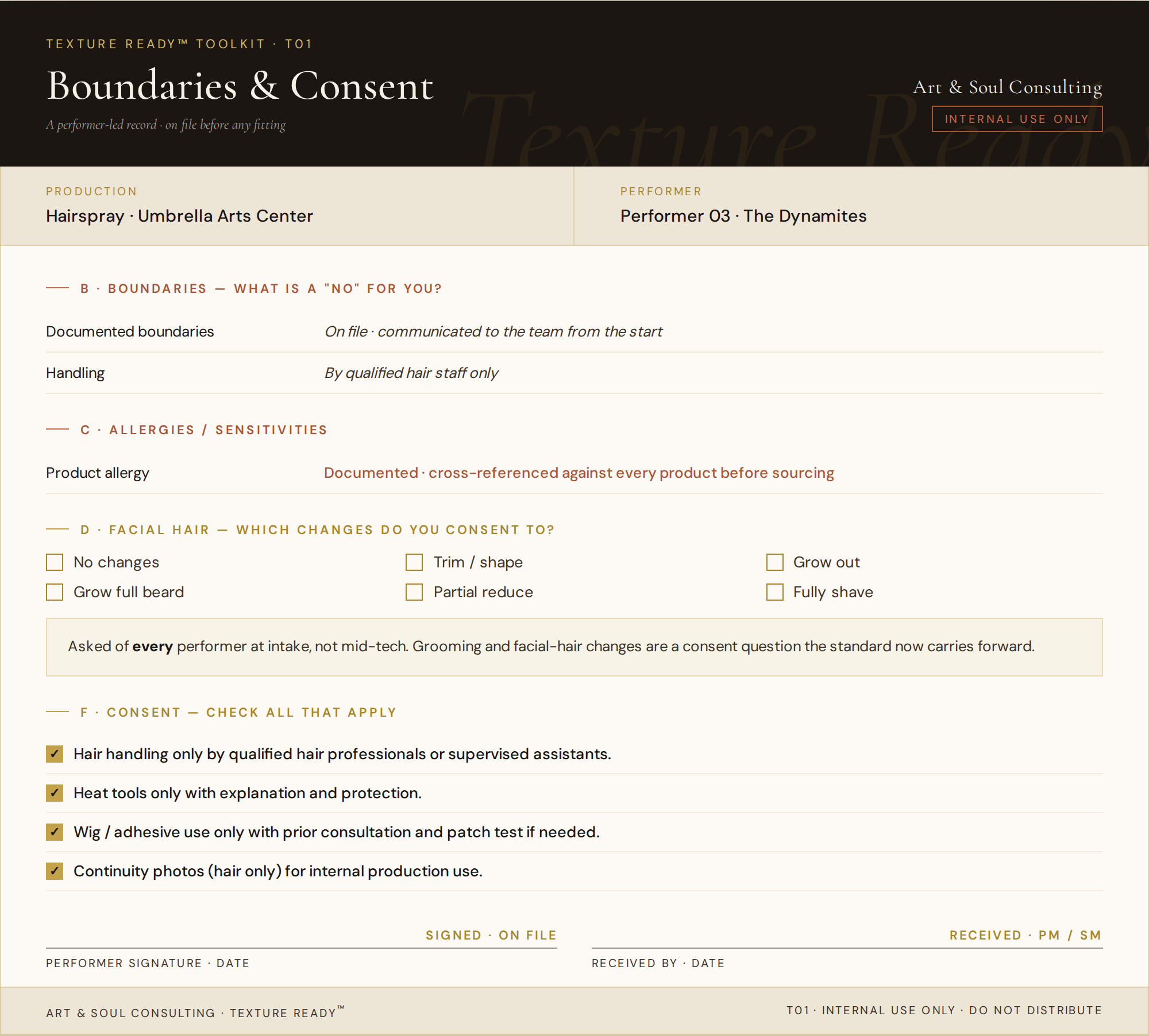
  • Performer hair intake and consent, capturing status, type, boundaries, and allergies.
  • Per-performer hair-plan one-pagers, documenting plan, vendor, and flags for each role.
  • Pre-determined hair budget, sizing textured-hair labor before casting was locked.
  • Allergy and boundary master flags, cross-referenced against every product before sourcing.
  • Daily hair-notes and continuity log for run-time tracking.

The instruments are proprietary to Art & Soul Consulting and are deployed within engagements rather than distributed.

Cite as: Art & Soul Consulting. (2026). Hairspray at the Umbrella Arts Center: The First Texture Ready™ Case Study. www.artandsoulconsulting.com/texture-ready · Quotations are drawn from recorded conversations and reproduced with permission, lightly edited for readability without change to meaning.

Is your production Texture Ready?

Train your people. Equip your production. Find out what it takes to plan for textured hair from the first hair call, not the night of first dress.

Or write directly: kiratroilo@artandsoulconsulting.com

Built on Unicorn Platform